
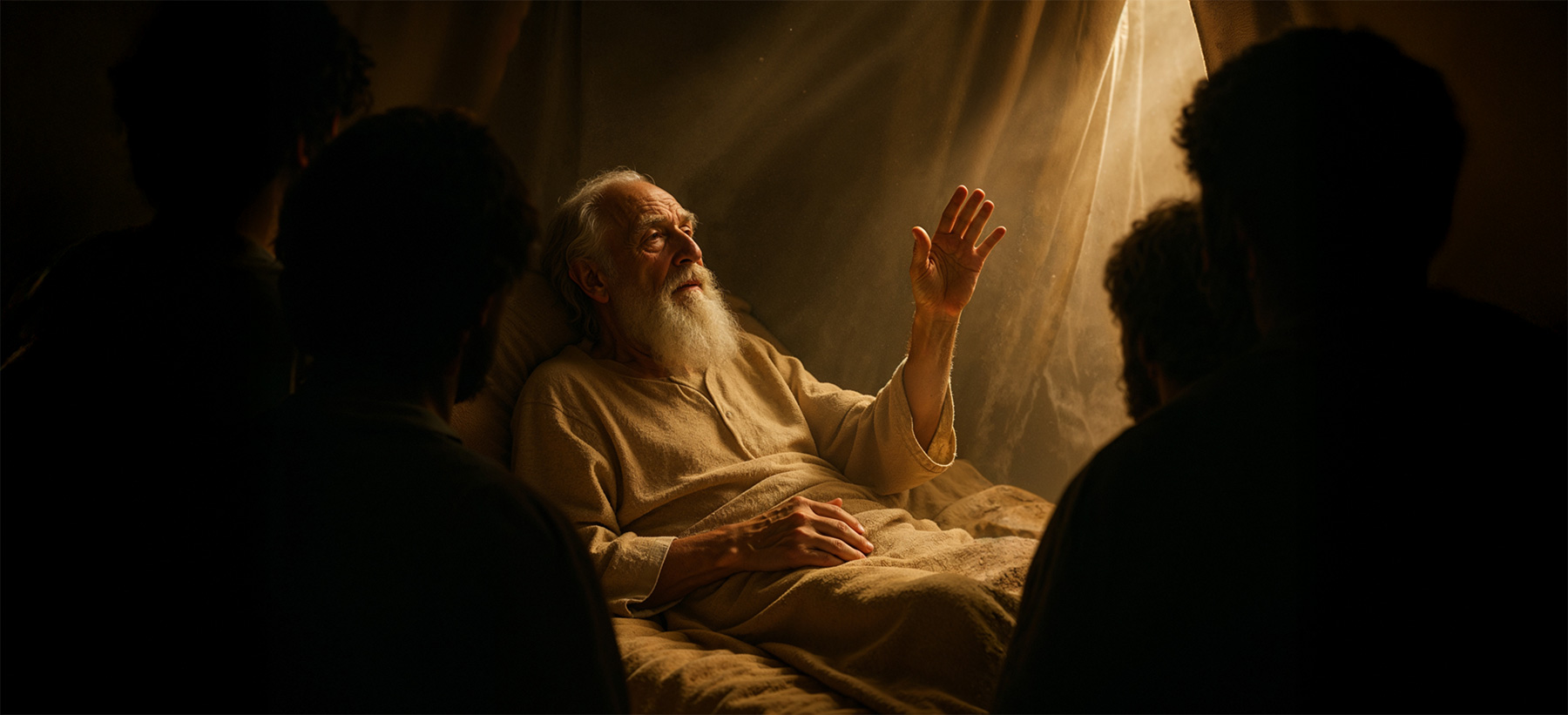
Jacob’s Blessings (Part Two):
Legacy, Character, and the Life God Intends
Genesis begins with creation, traces the generations of humanity, moves through the flood, and narrows its focus to one man: Abraham. With him, God establishes a covenant—a promise that through his descendants, the world would be blessed.
Abraham’s grandson Jacob—later renamed Israel (Genesis 35)—stood at the end of his life and spoke prophetic words over his twelve sons (Genesis 49). From them would come the twelve tribes of Israel. Blessings bring flourishing. Curses bring loss. And in Jacob’s final words, we see both.
Below are sons seven through twelve. While Part One focused heavily on how personal character shapes legacy, this final group reveals the spiritual battles, gifts, and ultimate calling of God’s people. These pronouncements were not only fulfilled historically—they still speak spiritually to those who believe.
“In the beginning was the Word, and the Word was with God, and the Word was God.” (John 1:1, NIV)
The Word has always been pointing somewhere.
Gad: Built for Battle
“Gad will be attacked by a band of raiders, but he will attack them at their heels.” (Genesis 49:19, NIV)
 Gad’s identity was forged in conflict. This tribe faced constant opposition by choosing to settle east of the Jordan River, exposing themselves as a target for constant raiding troops. Yet they would overcome.
There’s a striking echo here of Genesis 3:15: the serpent would strike the heel, but his head would be crushed. Jesus was wounded—but through the cross and resurrection, He defeated sin, death, and Satan. Just as Gad had to fight for the land they were promised, we must stand firm in the battles we face.
- Expect opposition but anticipate victory. Facing trials does not mean you have lost your divine destiny.
- Overcome evil with good. True spiritual warfare means pushing back darkness with persistent faith.
- Stand secure in Christ. The enemy may strike at your heels, but Jesus has already secured the final triumph.
Asher: The Blessing of Abundance
“Asher’s food will be rich; he will provide delicacies fit for a king.”(Genesis 49:20, NIV)
 Moses later prophesied that Asher would “bathe his feet in oil” (Deuteronomy 33:24)—a picture of extraordinary abundance, referring to fertile land rich in olives. In Scripture, oil often symbolizes the Holy Spirit.
Asher’s inheritance reflects more than agricultural prosperity; it mirrors spiritual fruitfulness. When the Spirit dwells within believers, the fruit produced is unmistakable: love, joy, peace, patience, kindness, goodness, faithfulness, gentleness, and self-control.
- Prioritize spiritual wealth. True abundance is measured by the condition of your soul, not your bank account.
- Cultivate lasting fruit. Holy Spirit character cannot be manufactured overnight; it must be intentionally grown.
- Feed the people around you. Your spiritual blessings are meant to be a life-giving feast for others.
Issachar: Strength That Chooses Service
“Issachar is a rawboned donkey crouching over the sheepfolds. When he sees how good is his resting place and how pleasant is his land, he will bend his shoulder to the burden and submit to forced labor.” (Genesis 49:14–15, NIV)
 Issachar’s blessing feels layered—strength paired with submission. This tribe was known for understanding the times and being willing to work. They valued peace over power and service over dominance.
Jesus redefined greatness the exact same way: “Whoever wants to become great among you must be your servant.” (Mark 10:43, NIV). Humility is not weakness; it is disciplined strength.
- Reframe your view of greatness. Real kingdom authority is found in a willingness to serve others.
- Submit your strength to God. Humility is simply power under control, yielded to a higher purpose.
- Understand your current season. True wisdom means knowing when to rest and when to bend your shoulder to the work.
Zebulun: A Place of Influence
“Zebulun will live by the seashore and become a haven for ships; his border will extend toward Sidon.” (Genesis 49:13, NIV)
 Zebulun became a thriving center of trade and prosperity. By bordering Sidon—the global capital of ancient commerce—this tribe was strategically positioned as a gateway to the wider world. Bustling fishing villages lined its coast.
Centuries later, Jesus began His ministry in this exact region of Galilee, calling local fishermen to become fishers of men. He transformed a commercial trading post into the launching pad for the Gospel.
- Connect prosperity to purpose. Earthly success is only meaningful when it becomes a platform for God’s work.
- Steward your sphere of influence. Where God has placed you geographically and professionally is your primary mission field.
- Value eternal impact over accumulation. Focus on opening doors for the Gospel rather than just building your own kingdom.
Joseph: Faithful Through the Fire
“Joseph is a fruitful vine, a fruitful vine near a spring, whose branches climb over a wall. With bitterness archers attacked him; they shot at him with hostility. But his bow remained steady, his strong arms stayed limber, because of the hand of the Mighty One of Jacob…” (Genesis 49:22–24, NIV)
 Jacob pictures Joseph’s life as a thriving vine whose branches outgrow its boundaries because they are deeply rooted next to a life-giving well.
Joseph’s actual life, however, was marked by betrayal, slavery, imprisonment, and false accusation. Yet because he stayed rooted in God, he never lost his strength. What others meant for harm, God used for good. Jesus echoed this upside-down reality: “Blessed are those who are persecuted because of righteousness.” (Matthew 5:10, NIV).
- Stay rooted when life gets bitter. Deep connection to God keeps you fruitful even during seasons of heavy attack.
- Let trial position you for purpose. Hardship is often the exact soil God uses to grow your ultimate calling.
- Trust the Sovereign hand. What your enemies designed to break you, God will purposefully use to build you.
Benjamin: Fierce and Generous
“Benjamin is a ravenous wolf; in the morning he devours the prey, in the evening he divides the plunder.” (Genesis 49:27, NIV)
 Jacob uses the fierce image of a ravenous wolf to describe Benjamin—a tribe that became known for relentless warriors who fought fiercely and shared their spoils.
There is a powerful parallel here with how we are called to approach the Word of God itself. Scripture describes it as living, active, and sharper than a two-edged sword. It cuts through deception, confronts the human heart, and defeats the enemy of the soul. When we fiercely hunger for God’s truth with that same wolf-like intensity and share it freely, lives are enriched.
- Hunger fiercely for truth. Approach God’s Word with a deep, relentless appetite to be filled.
- Fight through spiritual deception. Use the sword of the Spirit to actively protect your mind and heart.
- Divide the plunder generously. When God gives you a spiritual breakthrough, instantly share that wisdom with others.
Why This Matters Today
Every prophecy Jacob spoke came to pass. Yet these words were never just about geography or ancient tribal history. They revealed timeless spiritual realities:
- The blessing of obedience and the warning of compromise.
- The fruit of the Spirit and the cost of the flesh.
- The power of perseverance through hardship.
Moses later summarized this reality clearly to the nation of Israel: “See, I am setting before you today a blessing and a curse…” (Deuteronomy 11:26, NIV). Centuries later, Jesus came to fulfill the Law and the Prophets, bringing ultimate clarity to the entire narrative. He summarized all of Scripture down to two revolutionary commands:
“‘Love the Lord your God with all your heart and with all your soul and with all your mind.’ This is the first and greatest commandment. And the second is like it: ‘Love your neighbor as yourself.’” (Matthew 22:37–39, NIV)
Every ancient prophecy, promise, and warning ultimately leads back to this central focal point: a life deeply rooted in love for God and for others. This is the definition of a truly blessed life. Jesus did not come merely to manage curses; He came to break them. He teaches us how to live free, and that is why the Word still matters today.
Join the Conversation
Looking back across all twelve sons from this two-part series, which profile speaks most directly to the season of life you are in right now?
Are you navigating the personal character challenges of Part One—like overcoming instability (Reuben), managing intense emotions (Simeon & Levi), walking through a season of redemption (Judah), resisting compromise (Dan), or walking in freedom (Naphtali)?
Or are you experiencing the spiritual realities of Part Two—standing firm through opposition (Gad), cultivating spiritual fruit (Asher), learning the quiet strength of service (Issachar), leveraging your influence for a purpose (Zebulun), trusting God through a prolonged hardship (Joseph), or hungering fiercely for God’s truth (Benjamin)?
Drop a comment below and let’s talk about it!
Thank you for reading. I hope these reflections deepened your understanding and encouraged your faith. Until next time!
Blessings,
Nancy
Stay tuned.








Recent Comments